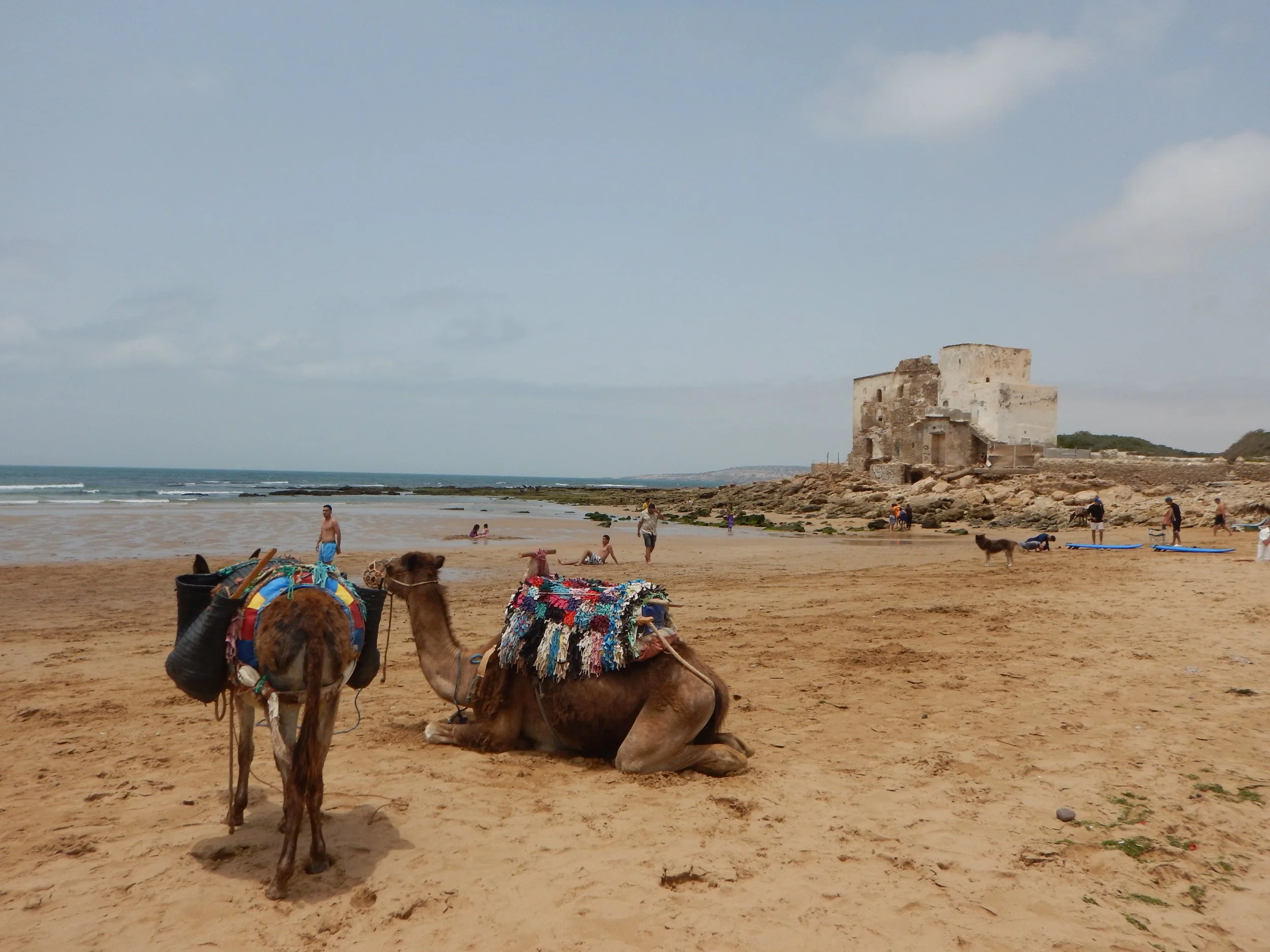
Sidi Kaouki: The Man, the Donkey and the Camel
By Emma de Jong
It was getting late. The sun was beginning to set over the horizon, its blinding halo blunting in the thickening atmosphere as it slowly made its angelic way down to earth, and beyond. Light glinted off the surface of the ocean, rippling like the waves rolling in. The sun-bathing beachgoers had long since packed up. The only occupants now sharing the space are a collection of men idling with their horses and a bunch of stray dogs lazing around.
She was hungry, eager to return to her room at the guest house, some 20-minute walk further into the countryside, to tuck into her dinner, wrapped carefully in paper and plastic from the store in town. Slowly, she rose from her perch, stretching out her stiff knees. The plastic bag crinkled as she lifted it too, and with that sound spelled the end.
One little orange dog trotted straight over to her. Looking up with those beady, desperate eyes. Straight through the plastic it smelt the grilled chicken, probably not caring as much about the salad, fries and bread. But that succulent chicken, the aroma of freshly cooked meat – she could understand its appeal.
When she next looked down there were four more. These were bigger, meaner, more scraggly looking beasts. Now, her heart rate picked up. They were edging in closer. They had the numbers on her. She feared the setting sun and regretted the solitude. She had languished long after the regular beachgoers and looking around there were only other animals for company. Dogs, horses, camels, and distracted men remained.
A bark. It was sharp, produced from a jaw with vocal cords made not for talking but for demanding. The sound drew attention – not the attention she desired. Across the sand, many more dog heads were being raised sleepily off of sand-covered paws. Strays live in packs if they want to survive.
Barking, the jaw open and shut. Teeth bared.
Oh. Now she thought of the teeth, those sharp canine points sinking into her dinner, or her leg. A big pack pile-up, with her crushed beneath their writhing bodies as they went feral tearing apart her bag, her clothes, her skin. She was worrying about a lot more than rabies.
She’s edging away slowly, heading for the exit where the men are still loitering, and the dogs are following. She wants even more strongly now to be home before the sun sets. Nighttime makes everything scarier. So she walks on, and they follow.
Sir bhalk. Go away, yells the voice of an older man.
She glances back, relieved for once to have been noticed by a man.
She sees a long pointy white muzzle extending back into two narrow eyes and goofily large triangular ears paired back and swiveled to the man perched above. He wears black pants and a sports t-shirt with a jacket over the top. He has a greying beard and evidence of previously dark hair wedged under a cap.
The man must be about 50 years old, yet somehow, like pets always come to resemble their owners, there is a spark of similarity between his pleasant warm features, and the white-grey faced donkey. A similarity that will soon be revealed as hard-working kindness, that comes with no expectations of repayment. Just doing his bit, in this patch of fabric of the world, that formed into the beautiful Sidi Kaouki.
It takes her a moment to register the camel lurking behind the man on the donkey. Looking around, she thinks not of the strangeness, but of the logic of this moment, in this place.
With the gruff man on donkey nearby, the dogs do not seem so frightening anymore, lurking around the legs of the camel, whose hoof is half the size of their heads.
With the sharpness of the man's voice, most of the dogs fall away.
Where are you going? He asks her, conscious of her discomfort with the dogs.
To the ranch down that road. She responds, indicating with her spare hand the path in the distance.
He happens to live in the same direction, so together they set off, her walking on the shoulder of the country road alongside the man atop the donkey. There is just one insistent little dog following on her tail. Despite knowing it cannot hurt her, its presence still leaves her uneasy and she does not want it following her home.
They make a rather unique small caravan; the man, the donkey, and the camel with its colourful rug; the girl dressed in her red sundress, and the hungry little dog still trotting behind them.
The man and the girl chat as they walk. She learns his name is Ibrahim and he offers tourists camel rides on the beach each day. He has been doing it for years. The work is easy, and he likes that he can offer visitors a unique experience.
After a way, the man notices that the dog is still bothering the girl, hungry and wanting her dinner. He hops off the donkey nimbly and instructs her to climb aboard. The height of the donkey only comes up to her waist – after all, they are not huge creatures, just strong and dedicated workmen.
Now the girl is atop the donkey and the man walks alongside, not needing to guide it on the path it has walked thousands of times. She is conscious of her short dress and the way it rides up her thighs, revealing her knees her the first time in this country, but Ibrahim doesn’t seem to notice. The camel trails behind, tethered to the pair. The dog remains there, following.
The girl claps her hands at the dog, and he pauses in his step, then continues on unperturbed. Then the man picks up a rock and rears, as if to throw it, and the dog stops in its tracks. He looks with longing eyes, then turns and scurries away a couple steps. When it comes back, the man throws the rock.
It is better he goes back to his pack while it is still light outside, he says and as they continue on, the dog scurries shamelessly back to the town.
It is still light outside, in that wish-washing twilight kind of way, where ordinary things feel magical, and the absurd just makes sense.
They come to an empty lot and the man instructs her to wait. Patiently, perched atop the donkey she watches as he unloads big empty plastic bottles and fills them with water from a tap. The water flows out in a constant gurgling stream, clear, thick, and lumpy.
Once the bottles are full of water, the man uses rope to attach them to the rods on the camel’s colourful saddle. Watching, she thinks about how heavy each bottle looks. Then she considers her own body weight and realises carrying 20 litres of water must be light work for that camel that carts tourists up and down the beach each day.
After completing his errands, the caravan of 4 wandered all the way to the gates of the ranch. The sun must have sunk below the horizon now. It is not yet so dark that she cannot see Ibrahim’s face clearly as he turns to say goodbye.
Sliding off the donkey, the girl smiled sweetly and thanked the man profusely; for scaring the dogs away, walking her home, and letting her ride the donkey.
It feels so rare in this world for a man to ask nothing of her; not a cent, not a helping hand, not her number. He who does good, meets good, or so they say.